
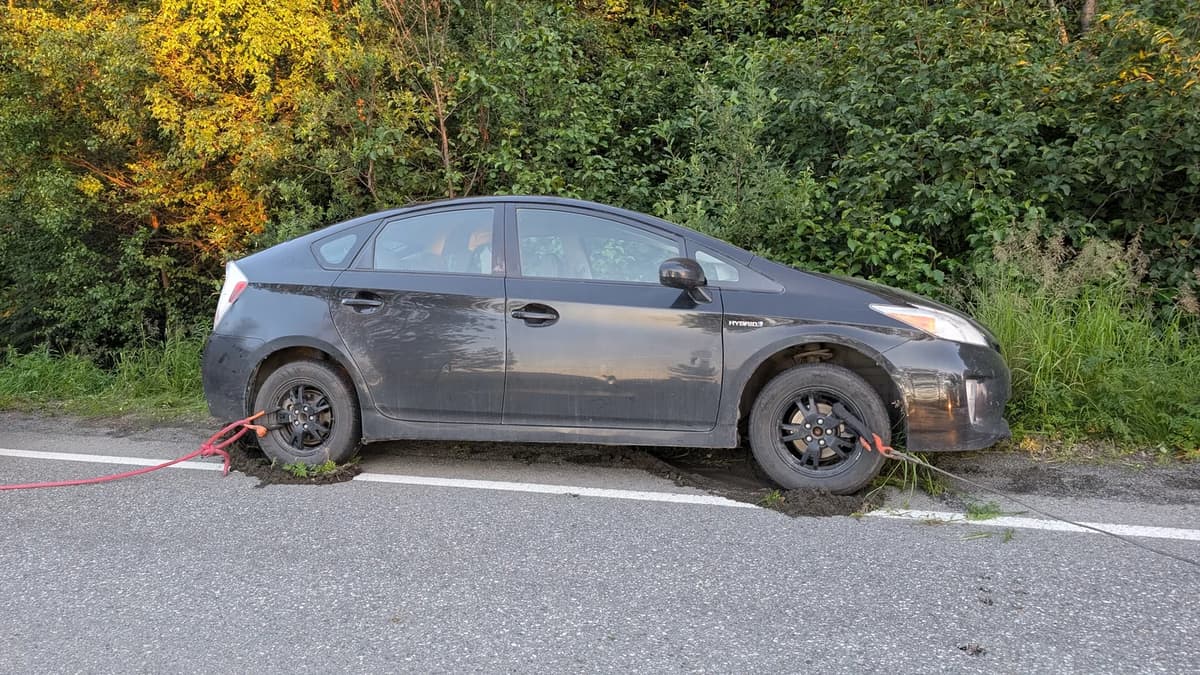
This Prius went into the ditch in the middle of summer, with no snow anywhere in sight.
Ask most people when cars end up in Alaska ditches and they will say winter. The Prius in this photo went in during the middle of summer, on a dry day. Summer roads feel forgiving, and that is part of the problem: speeds creep up, attention drifts, and a shoulder that looks solid can give way under one wheel.
If anyone is hurt, the vehicle is blocking traffic, or you smell fuel or see smoke, call 911 first. Otherwise, this guide explains why summer ditch calls happen and how to handle one without making it worse.
Why cars leave the road in summer
- Soft gravel shoulders that grab a wheel and pull the car toward the slope.
- Tall grass and fireweed that hide how steep or close the ditch really is.
- Pulling over quickly for a phone call, a view, or a moose in the road.
- Loose gravel and fresh chip seal in construction zones.
- Long daylight and long drives, which make tired drivers easy to overlook.
- Heavy rain that softens road edges and leaves water standing at the bottom.
If one wheel drops off the pavement
The instinct is to jerk the wheel back toward the road, and that is often how a small mistake becomes a serious one. Ease off the throttle, keep the steering steady, and let the car slow down. Once your speed is low and the road is clear, steer back gently. If the ground is sloping away from you, stop on the firmest spot you can reach rather than fighting it.
Once you are in the ditch
Check on everyone, turn on your hazards, and look at traffic before you open a door. Get out on the side away from the road if you can do it safely, and wait well back from the lane. A car resting on a slope can shift, so do not stand on the downhill side.
Switch the engine off if the vehicle is sitting in dry grass. A hot exhaust system can ignite dry vegetation, which is a real summer risk that winter ditches do not have. Do not leave it idling for the air conditioning while you wait.
Avoid trying to drive out. Spinning the tires digs them into soft ground, and on a side slope it can pull the car further down. Pushing and pulling by helpful passersby can also go badly, because a strap under load can snap, and people end up standing where the car could roll.
What makes a summer recovery different
Soft ground is the main thing. Wet soil, peat, and sand may not hold a wheel, and the truck also needs firm footing on the shoulder to pull from. The operator has to judge the angle, where the straps can attach without damaging the car, and whether traffic control is needed. A controlled pull usually brings the vehicle back up the way it came, and the photo above shows the sort of wheel straps that can be used on a low car.
Low clearance needs extra care. Sedans and hybrids have plastic underbody panels that can catch on the bank, so the pull has to be slow and planned. Hybrids and electric cars also have their own rules about being moved, so it helps to have the owner's manual handy and to mention the drivetrain when you call.
Before you drive away
A car that looks fine may not be. Walk around it and check for grass or brush packed against the exhaust, a torn underbody panel, tire sidewall cuts, or leaking fluid. If the steering wheel sits crooked, the car pulls to one side, a warning light appears, or you hear a new noise, stop and ask for a flatbed tow to your mechanic rather than testing it on the highway. Our guide to choosing a tow to home or to the mechanic can help with that decision.
What to send us
Text a map pin, your direction of travel, and photos taken from the road and from the side of the vehicle. Show how far it sits from the pavement, how steep the slope is, and whether there is water, a culvert, or a fence nearby. Tell us the year, make, and model, and whether it is a hybrid, an EV, or all-wheel drive. Those details let us bring the right equipment and give you a useful estimate before dispatch.
Recovery is priced by zone and by the time the job takes, and the details are on our pricing page. If you are unsure whether you need recovery or simply a tow, send the photos and ask. Whatever the season, a quick look at the scene beats guessing from the side of the road.
Related information
- Roadside recovery and winching
- Tow to home or to the mechanic?
- Palmer towing
- Wasilla towing
- Highway Towing and Recovery
- Photos: Ditch, mud, snow, and river recovery