
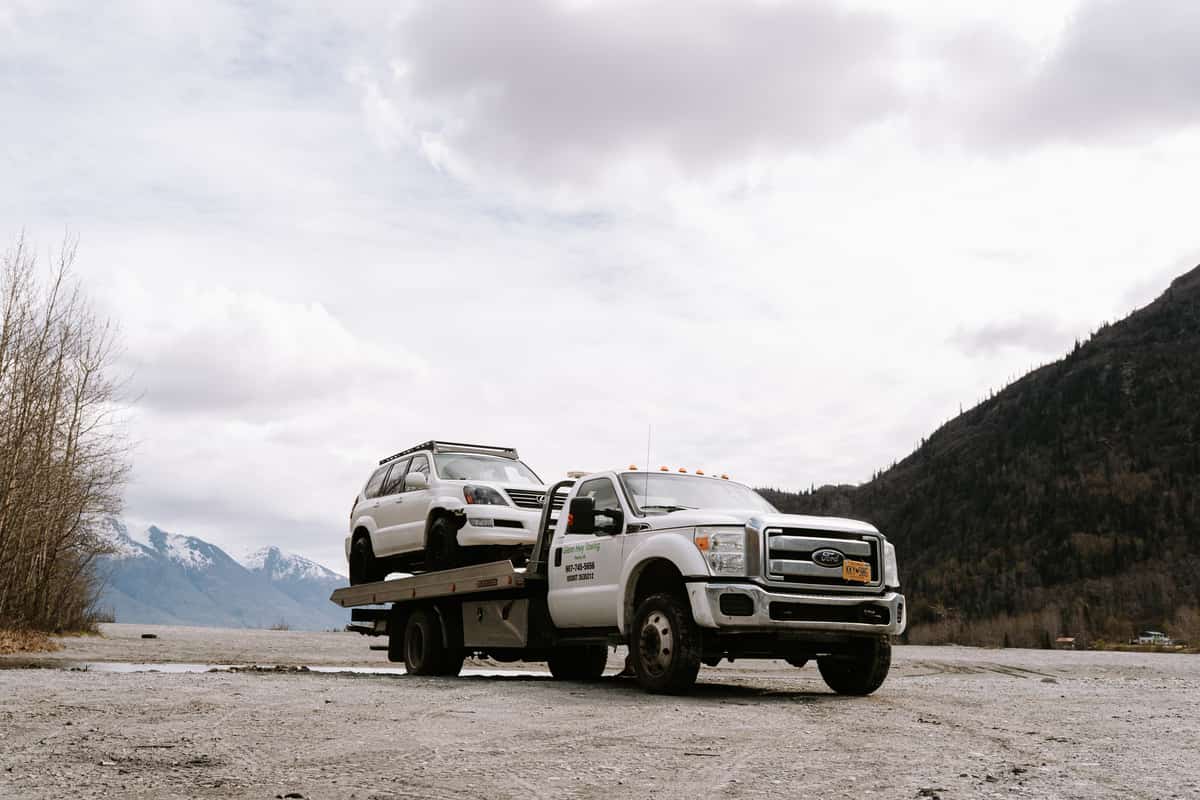
A flatbed carries all four tires off the road, but the vehicle still must be compatible with the deck and loading approach.
All-wheel-drive systems do not all share one towing rule. Some vehicles allow a limited method under specific conditions; others require all four wheels off the ground. The towing section of the exact owner's manual is the controlling source.
A dispatcher needs the year, make, model, drivetrain, operating condition, and visible damage before confirming the method. Guessing from a badge or assuming that every AWD vehicle behaves the same can create avoidable risk.
What each towing method does
A wheel-lift raises one axle while another remains on the road. Dollies can sometimes carry the remaining wheels, but the permitted setup depends on the vehicle and the equipment. A flatbed draws the vehicle onto a deck so all four tires are carried during transport.
Keeping every tire off the roadway avoids continuous road rotation during the trip. It does not remove the need to follow the manual, release the parking brake correctly, use an approved transport mode when required, and secure the vehicle at appropriate points.
Why vehicle condition matters
A vehicle may not power on, select neutral, steer normally, or release an electronic parking brake after a mechanical or electrical failure. Collision damage can also lock a wheel or leave bodywork close to the ground. Those conditions change the pull onto the deck even when flatbed transport is otherwise suitable.
Electric and hybrid models may have shutdown, high-voltage, or transport-mode instructions. Report a damaged, hot, smoking, leaking, or warning-marked battery immediately. That is not a routine loading detail.
Clearance is part of compatibility
The loading angle must clear the front overhang, center of the wheelbase, exhaust, rear bodywork, and any splitter or side skirt. Lowered suspension, a flat tire, broken control arm, steep driveway, or soft shoulder can reduce clearance at one part of the path.
Send side photographs of the whole vehicle, each wheel, low bodywork, and the open area behind the intended loading position. This lets the operator review both the vehicle and the approach instead of discovering a conflict after arrival.
Information to send before dispatch
- Exact year, make, model, and AWD or 4WD configuration.
- The towing or transport instruction from the owner's manual when available.
- Whether the vehicle powers on, rolls, steers, and releases the parking brake.
- Any collision damage, battery warning, suspension change, or reduced ground clearance.
- Photos of the vehicle and enough surrounding space to judge the loading approach.