
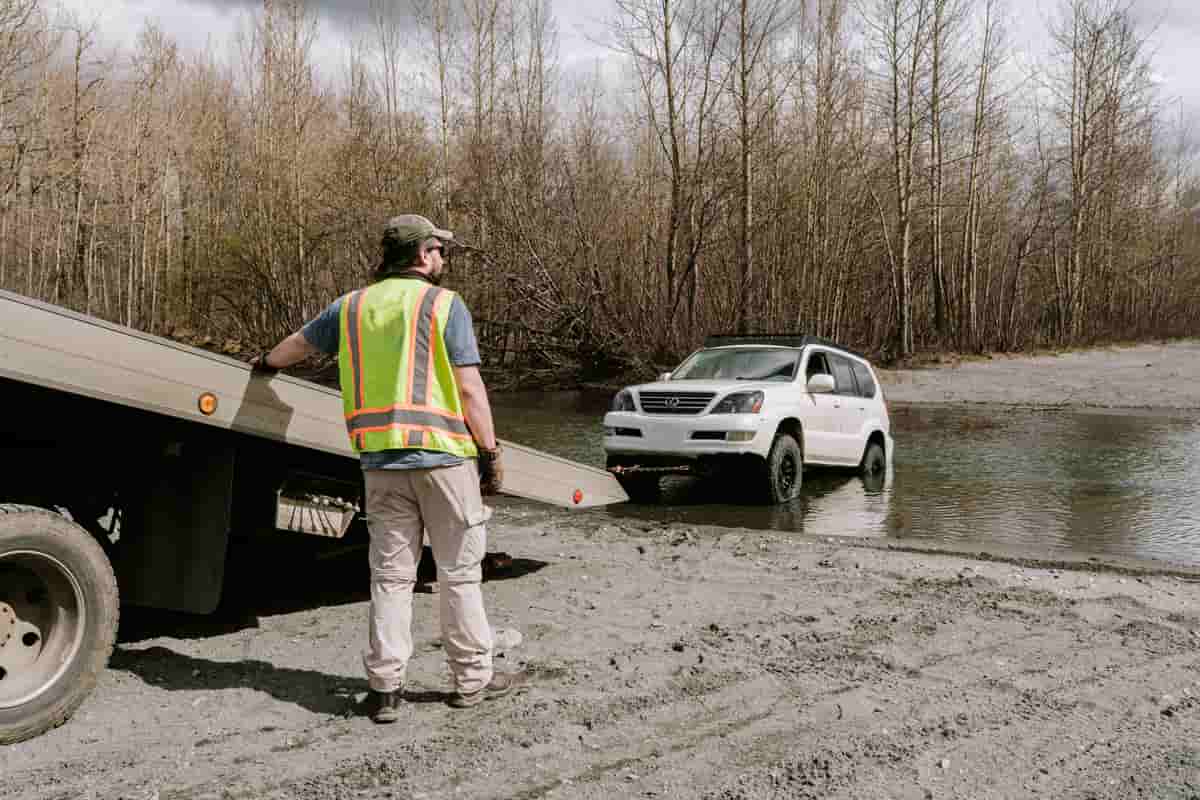
Recovery planning begins with the vehicle's position, surrounding terrain, and a safe place for the truck.
A vehicle can run normally and still need recovery because its tires no longer have firm ground. It can also reach the road after a pull but need towing because a tire, steering component, cooling system, or body panel was damaged in the slide-off.
That is why winching and towing are separate questions. One changes the vehicle's position; the other transports it to a destination.
A winch-out addresses position
A typical review starts with a vehicle near an accessible roadway in a shallow ditch, snowbank, or soft shoulder. The operator needs a stable truck position and a controlled pull path that does not cross unsafe traffic or obstacles.
Deep off-road locations, steep slopes, water, unstable ground, trees or barriers in the pull path, and sites without safe truck access may exceed a light-duty roadside recovery. A pin and wide photographs are necessary before the job can be accepted.
A tow addresses condition or destination
Once the vehicle returns to firm ground, check whether the wheels roll freely, steering responds, tires hold air, fluids are leaking, and loose bodywork can contact a tire. If driving is unsafe or uncertain, load it for transport rather than treating the successful pull as the end of the call.
Some calls need only a controlled recovery. Some need only a tow from the shoulder. Others need recovery first and flatbed transport second. The estimate should identify which parts are expected from the information available.
Stop before tire spinning makes it worse
Repeated acceleration can polish snow into ice, bury the drive wheels, or settle the frame onto packed snow. It can also move the vehicle into a less stable angle. Stop when a gentle attempt is not producing controlled movement.
Keep people away from the downhill side and out of any possible cable or vehicle path. Do not attach a strap to suspension, steering, or body parts. The operator must choose the attachment and pull direction after seeing the vehicle.
Photograph the whole recovery scene
- One wide view from the road showing the vehicle and possible truck position.
- Front, rear, and both sides of the vehicle.
- Close views of buried tires, underbody contact, and visible damage.
- The slope, ditch depth, snow condition, guardrails, trees, mailboxes, and overhead obstacles.
- A location pin plus road name and travel direction.