
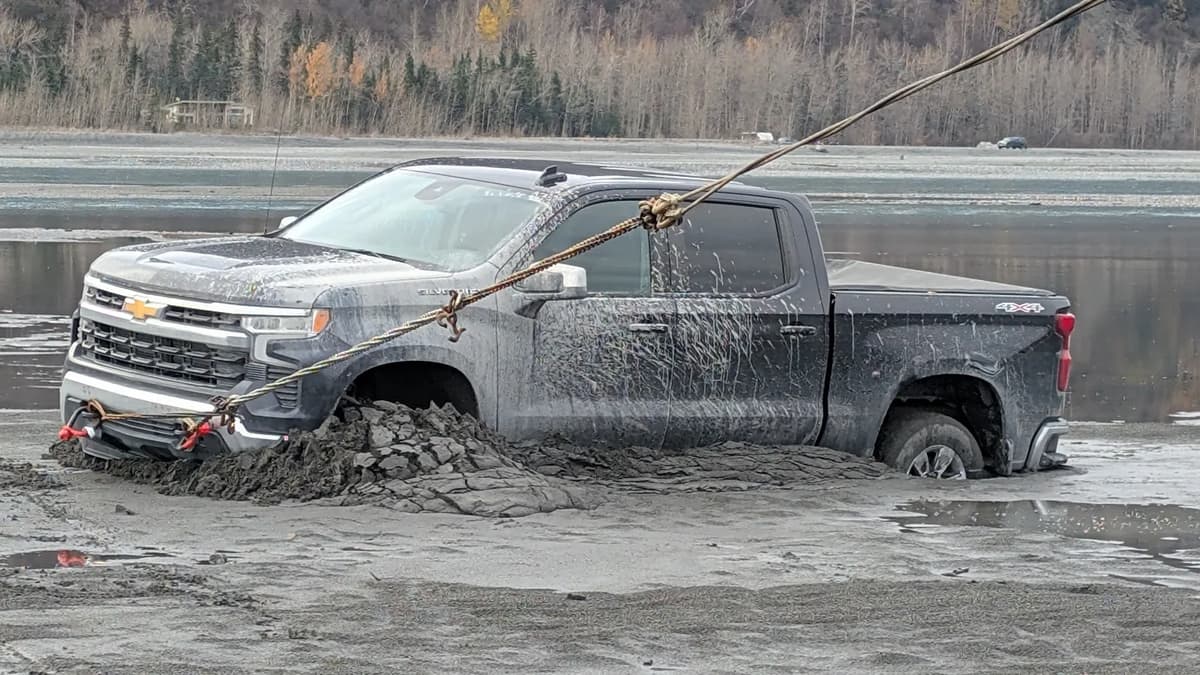
A vehicle sunk to its axles has mud holding it from every side, which takes careful rigging to overcome.
Getting stuck is often a small problem that grows. A vehicle with one soft wheel can usually come out with a straightforward pull. Ten minutes of throttle later, the same vehicle can be sitting on its frame with mud packed around the axles.
This guide covers what to avoid and what to do instead. It is general advice, so use your own judgment about the conditions, and call 911 first if anyone is hurt or in danger.
Do not keep spinning the wheels
If a light touch of the throttle does not move the vehicle, more power rarely helps. Spinning tires dig down, polish the mud, and throw material into the wheel wells. It can also overheat the transmission or strain the drivetrain, turning a stuck vehicle into a repair.
Rocking between drive and reverse has limits too. Done gently for a try or two, it may free a vehicle that is barely caught. Done repeatedly, it digs the hole deeper at both ends of the wheel's travel.
Be careful with straps and helpers
A well-meaning friend with a pickup is where many mud stories go wrong. Yanking on a strap attached to a bumper, trailer ball, or plastic tow eye can tear parts off the vehicle. A failed ball or shackle can fly with enough force to injure someone or punch through a window.
A second vehicle can also become a second stuck vehicle. If your helper's truck has to leave firm ground to reach you, stop and reconsider. Two vehicles in the mud cost more to recover than one.
Things that seem clever but cause damage
- Jacking the vehicle on soft ground, where the jack can sink or the vehicle can shift.
- Stuffing floor mats under spinning tires, which can launch them or shred them.
- Deflating tires a long way from pavement with no way to refill them.
- Digging beneath the vehicle or crawling under it while it is unsupported.
- Leaving the engine idling while the exhaust outlet is close to mud, water, or snow.
What helps while you wait
Shut off the throttle and keep the vehicle in a stable position. Take photos before anything changes: all four sides, the depth at each wheel, and the path back to firm ground. Note any fluid leaks, because a leak can change how the vehicle should be handled.
Send a GPS pin while you have service, then conserve your phone battery. Remote mud may have no cell signal, so tell someone your location before walking anywhere to find coverage. Keep warm clothing and water with you, because a wait can take longer than expected.
Why reach matters for a recovery
A tow truck needs firm ground of its own. Our road-accessible recovery work covers vehicles near a surface the truck can safely use. Deep mudflats, trails, and off-road locations are reviewed from photos and a pin first, and some are fulfilled by trusted recovery partners. Being upfront about how far you are from solid ground gets you a realistic answer sooner.
Knowing when to stop trying
A simple rule helps: give yourself one or two gentle attempts, then stop and look. If the vehicle has not moved, or the tires have dropped lower, another attempt will not improve things. Check whether the frame or differential is resting on the mud. If it is, the wheels no longer carry the weight, and traction aids will do little. That is the moment to take photos and call. Stopping early often means a shorter pull, less cleanup, and less risk of damage to the transmission and the underside of the vehicle. It also leaves the ground around the wheels firmer for whoever does the recovery.
Related information
- Recovery and winching details
- Recovery photos from real calls
- Request an off-road recovery review
- Wasilla towing
- Willow towing