
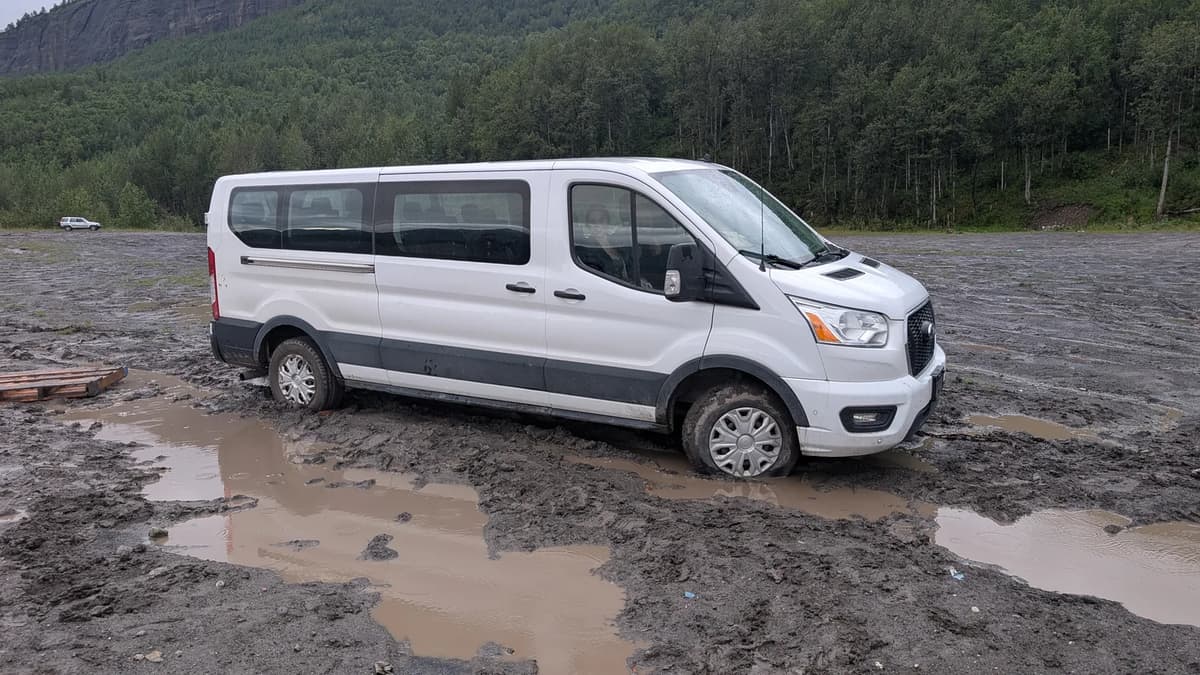
Standing water and soft ruts are a warning sign that the ground will not hold a loaded vehicle.
Breakup is the stretch of spring when snow melts faster than frozen ground can drain it. The top few inches turn soft while the layer below stays hard, so water has nowhere to go. A driveway that carried a truck all winter can swallow the same truck in April.
Most breakup calls happen in ordinary places: a gravel driveway, a lot edge, a pull-off, or a shoulder that looked firm from the driver's seat. Knowing how that ground behaves can save you a recovery, and it helps you describe the job accurately if you still need one.
Where vehicles get caught
Road shoulders are a common trap because the pavement edge looks like a safe place to stop. Meltwater collects along that edge and softens the material just beyond it, so a wheel can drop quickly once it leaves the pavement. Driveway edges, turnarounds, and any spot where a plow piled snow all winter stay wet longer than the ground around them.
Gravel lots can also mislead you. A surface crust may hold your weight at walking speed and give way under a turning front tire. Tracks from another vehicle do not prove the ground is solid, because earlier drivers may have crossed before the afternoon thaw.
Check the ground before you commit
- Walk it first. If your boot sinks or water wells up around your step, a vehicle will sink farther.
- Look for dark, shiny patches, standing water, and ruts left by other vehicles.
- Remember the time of day. Ground that was firm at 7 a.m. can be soft by mid-afternoon.
- Back in only if you can pull straight out. Turning under power is what usually breaks through the crust.
- Ask delivery drivers and guests to stay on the hard surface until the driveway dries.
If a wheel breaks through
Stop as soon as forward progress stops. Spinning the tires digs a trench, packs mud into the wheel well, and can leave the vehicle resting on its frame. A vehicle sitting on its frame is harder to pull, and that usually means more time on the job.
Do not wedge a jack under the vehicle on soft ground or hook a tow strap to a bumper cover or plastic tie-down point. If a strap or recovery point fails under load, it can become a dangerous projectile. Leave the vehicle stable, shut it off if it is not needed for heat, and keep people clear of it.
What to send for a recovery estimate
Photos answer most of the questions a dispatcher needs to ask. Take one from each side of the vehicle, one of the stuck wheels, and one from where a truck would have to park. Show how far the vehicle sits from firm ground, because that gap shapes where the tow truck can safely set up.
Add a GPS pin, the vehicle's year and model, whether it runs and steers, and any overhead lines, fences, or trees close to the pull path. A vehicle near firm pavement is usually a roadside recovery. A vehicle far from any solid surface needs a closer look, because the recovery truck can get stuck on the same ground. Those jobs are quoted after review and may be declined if a safe setup is not available.
Keeping the driveway usable until it dries
If your own driveway is the trouble spot, keep traffic on one firm line rather than letting ruts spread across the surface. Move heavy deliveries to a dry morning when you can, and ask fuel or septic drivers about the ground before they turn in. Open ditches and clear culverts so meltwater has somewhere to go. A vehicle parked on a soft edge can settle overnight, so park on the firmest part of the lot during the worst weeks of thaw.
Related information
- Roadside recovery and winching
- Stuck in mud: what to avoid
- Request a recovery estimate
- Palmer towing
- Wasilla towing
- Sutton towing
- Photos: Ditch, mud, snow, and river recovery