
Roadside safety
RV Breakdown Preparation for Alaska Road Trips
By Palmer Towing and Recovery · Published
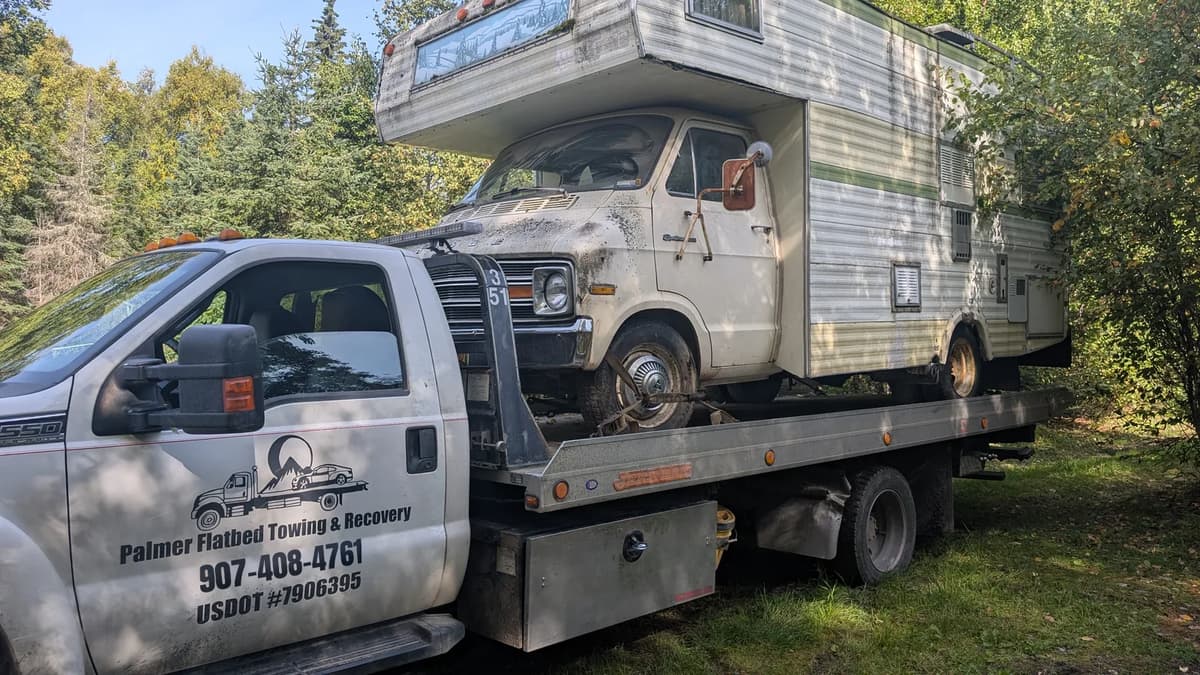
A smaller, older motorhome moved by flatbed. Weight and dimensions decide whether a given RV fits.
Alaska roads draw RV travelers every summer, and long distances between towns make a breakdown a bigger event than it would be in many places. Services can be spaced far apart, and cell coverage is not guaranteed between them.
A little preparation before you leave helps. So does knowing that not every RV can be handled by every truck. Size, weight, and location decide who can help, and it is better to learn that from an honest conversation than after a truck arrives.
Keep the key numbers where you can find them
Write down your RV's length, height, width, and gross vehicle weight, along with its year, make, and model. Add the same details for anything you tow behind it. These numbers are often the first question a dispatcher asks, and they are hard to find when you are stressed and standing on a shoulder.
Photograph the data plate or weight sticker and save it on your phone. Keep your roadside plan, insurance card, and registration together. Check whether your coverage has a towing limit or requires you to call a particular number first.
Our flatbed has real limits
We run a light-duty flatbed. That suits many cars, pickups, and some smaller or older RVs, but it is not the right truck for a large Class A motorhome or a heavy coach. Those vehicles generally require heavy-duty equipment. If your RV is outside what we can safely haul, we will say so and you can move on quickly to a company equipped for it.
Even a smaller RV gets a closer review. A high center of gravity, a long rear overhang, and low clearance at the hitch or tail can each complicate loading. Sending photos of the side profile and the ground around the vehicle is a big help.
Packing and preparing for a tow
- Latch cabinets, close the fridge, and secure anything that could fall or slide.
- Close slide-outs and retract awnings, steps, and jacks if you can do so safely.
- Shut off propane at the tank and follow your manual's guidance for appliances.
- Take medication, documents, phones, chargers, and valuables with you.
- Empty loose items from roof racks and rear-mounted carriers if possible.
Where you stop makes a difference
If the RV is still moving and you can do it safely, aim for a wide turnout, a firm lot, or a campground entrance rather than a narrow shoulder. A large vehicle takes a lot of room to load. Soft shoulders are a particular risk for heavy vehicles, so stay on firm ground. Use hazard lights and reflective triangles when it is safe to set them out, and call 911 first if the RV blocks a lane or anyone is at risk.
Share your milepost, direction of travel, and a GPS pin. If you are traveling with pets or children, say so early, since that affects how everyone gets to the destination. Our separate guide on pets and passengers covers this in more detail.
Planning the destination
Repair options for a large RV are narrower than those for a car. Not every shop can fit a motorhome through its doors, and some work only on the chassis or only on the living area. Call before you request a tow and ask whether the shop handles your type of RV, how long the wait is, and where you could stay in the meantime. Ask about parking, since you may be living in the RV or need access to your belongings. Campgrounds can be full in summer, so have a backup. If you are traveling with a rental, call the rental company first, because many have their own required steps for breakdowns and repairs.
Related information
- Camper and motorhome photos
- Truck camper breakdowns
- Highway towing and recovery
- Long-Distance Towing
- Sutton towing
- Willow towing