
Vehicle transport
Truck Camper Breakdowns: Can a Flatbed Help?
By Palmer Towing and Recovery · Published
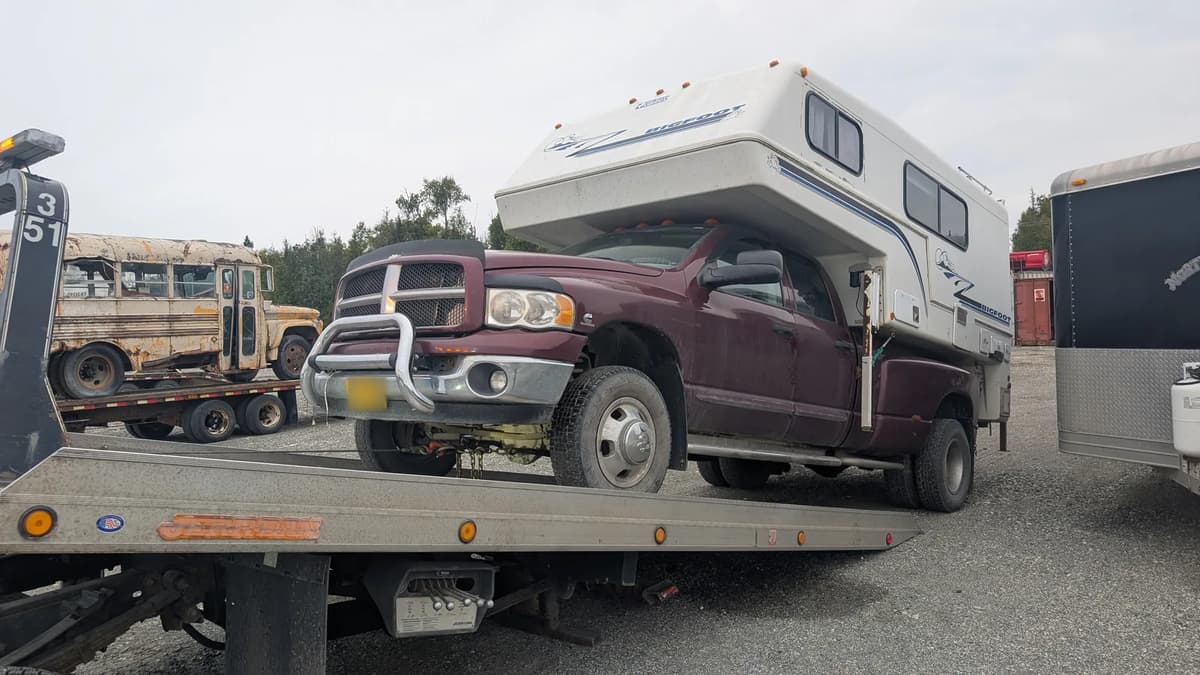
Loading a pickup with its camper still on board calls for a slow pull and a careful look at clearance.
When a pickup carrying a slide-in camper breaks down, the first question is usually whether the two can stay together. Taking a camper off a truck takes jacks, level ground, and time, and it leaves you with two things to move rather than one.
Keeping the camper on board can work when the combined weight fits the truck, the load height clears the route, and the loading path is workable. These are the details that decide it.
The numbers that matter
Combined weight comes first. A camper may add thousands of pounds to a heavy-duty pickup, along with water, gear, and food. Find the camper's dry weight, then add a realistic estimate for what you are carrying. Draining fresh water can reduce the load if you have a safe and legal way to do it.
Height comes next. A pickup with a cab-over camper is already tall, and placing it on a flatbed deck raises it further. Measure from the ground to the highest point of the camper, including vents and air conditioning units. Bridges, power lines, trees, and shop doors all need to clear the loaded height.
Why the tilt of the deck matters
As a truck rolls up a tilted deck, its weight shifts and the camper overhang swings. A camper that extends past the rear bumper can come close to the deck or ground as the angle changes. A slow, controlled winch pull helps, along with photographs that show how far the camper sits beyond the truck on each end.
The condition of the truck also affects the plan. A failed transmission may leave a truck that rolls in neutral but cannot power itself. A locked wheel, broken axle, or collapsed suspension can make the pull more difficult and needs to be mentioned early.
What to send
- Truck year, model, and whether it has single or dual rear wheels.
- Camper make, model, and estimated loaded weight.
- Total height, measured from the ground to the highest point.
- What failed, and whether the truck rolls, steers, and shifts into neutral.
- Photos of the side profile, both ends, and the space around the truck.
- Your exact location, plus the destination's address and hours.
Before loading day
Secure the inside as you would for a rough road. Latch cabinets, stow loose items, and turn off propane at the tank. Check that camper tie-downs and turnbuckles are snug, because they will be holding the camper through the tilt of the deck.
If the camper is not safely fastened or the combined load is beyond what our truck can handle, the honest answer may be to remove the camper or find heavier equipment. Tell us where you are camped too. A campground road may have tight turns and low branches, and a truck needs enough room to line up and leave.
Finding a shop first
Transmission and engine repairs on a heavy pickup may not be available everywhere, so call ahead to confirm a shop can take your truck and fit it with a tall camper attached. A longer haul is quoted from mileage, so knowing the destination before dispatch gets you a firmer estimate.
When removing the camper is the better call
If the combined load is too heavy or too tall, taking the camper off may be the simplest way forward. That requires working jacks, firm and level ground, and enough room to drive or winch the truck out from under the camper. A campground site or a large gravel lot may work, while a road shoulder generally will not. Get permission from whoever manages the site, and ask how long the camper can stay. Secure it, lock it, and take your valuables with you. Then the truck can be handled as an ordinary pickup tow.
Related information
- Truck camper tow photos
- Long-distance towing
- RV breakdown preparation
- Flatbed Towing
- Sutton towing
- Palmer towing