
Vehicle transport
Towing Lowered Cars and Sports Cars on a Flatbed
By Palmer Towing and Recovery · Published
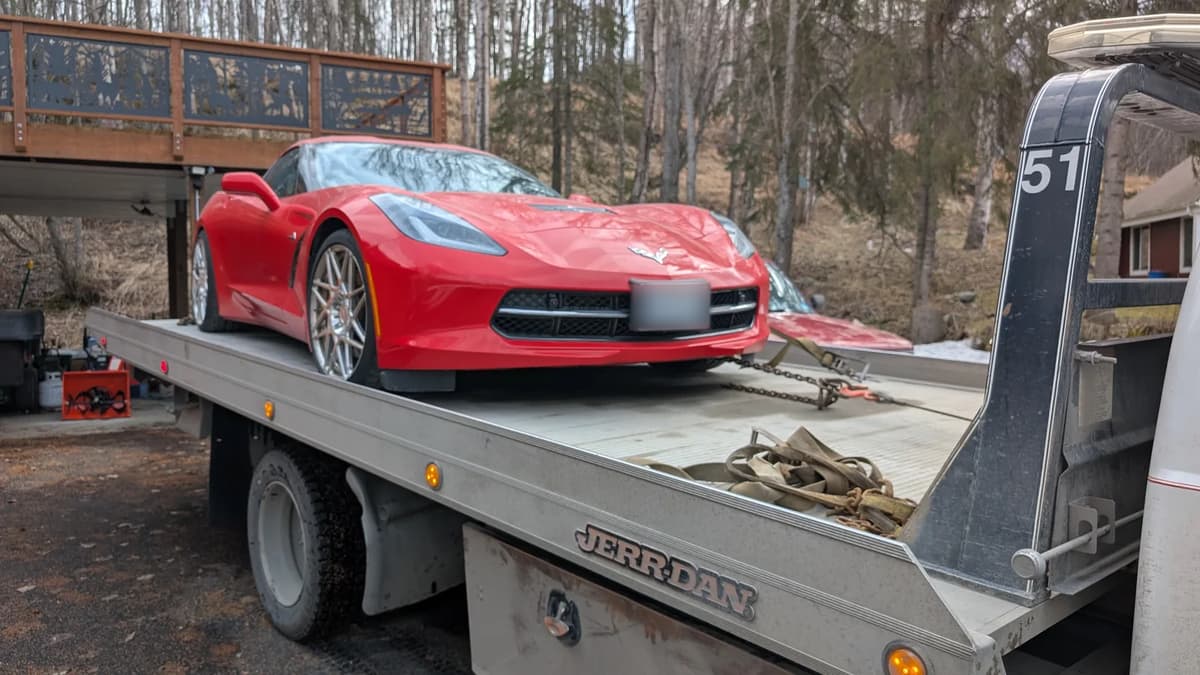
A low front end needs a gentle approach angle during loading and unloading.
Alaska has a short season for sports cars, and owners tend to care a lot about how they are handled. A flatbed is usually the right way to move them because all four wheels ride on the deck. The risky part comes during loading, while the car transitions from the ground to the angled deck.
The same applies to lowered cars, cars with splitters and side skirts, and any vehicle with long overhangs. Here is what to check and how to share it.
Where low cars make contact
Three angles do most of the damage. The approach angle decides whether the nose hits the deck. The breakover angle decides whether the middle of the car touches at the deck's hinge or its end. The departure angle decides whether the rear bodywork scrapes as the car climbs. Long wheelbases and long overhangs make all of them worse.
A flatbed's deck tilts at a set range of angles, so the surface around the truck matters. A slope in the wrong direction makes the angles steeper, while a flat, paved spot gives the most room. Sometimes moving the car a short distance to a better spot can make a real difference.
What to measure and photograph
- Ground clearance at the front lip or splitter, using a tape measure.
- Side skirts, exhaust tips, and diffusers that hang below the body.
- A side-profile photo taken at car level, showing the gap under the vehicle.
- Any aftermarket wheels, brake kits, or wide tires.
- A photo of the ground behind the car, where the deck will land.
Tie-downs and wheels
Straps over the tires keep the car secure while letting the suspension move on the road. That matters on cars with expensive wheels and delicate suspension parts, where a hook in the wrong place could do damage. Tell us if your wheels are unusually large or easily marked, or if your owner's manual specifies particular tie-down points.
Check your manual for a transport mode too. Some modern cars and electric vehicles have specific steps for neutral and parking brake release, and some have to be powered on before they can roll. Hybrids and EVs may need a manufacturer's shutdown procedure, and a damaged or warning-marked battery needs to be disclosed right away.
Preparing the car and the spot
If air suspension is fitted, raise the car to its highest setting before loading. Remove a detachable front lip if it is designed to come off. Fold or remove anything that sticks out, and photograph the car from every side for your records.
If the car is in a garage, confirm it can get out far enough for the truck to line up. A low car on a steep driveway may need to be moved to a flatter surface. If it will not start or roll, tell us, because a winch pull on a low car has to be set up carefully. Clean up gravel or ice that could add to the risk if you can do so safely.
Set the expectation together
Loading a low car is slow by design. With a good plan, it is routine. Sometimes the combination of bodywork and pickup site calls for a different plan, and that is better discovered from photos before dispatch than with the car halfway up the deck. Send the details and we will tell you honestly whether the setup will work.
If the car has a transport mode
Some performance cars have a specific neutral or tow setting in a menu. Look it up before the truck arrives and keep the instructions on your phone. It can be hard to find on the side of a road, and the operator cannot be expected to know every model's procedure.
Related information
- Classic and sports car photos
- Car towing
- Towing a classic car
- Flatbed Towing
- Eagle River towing
- Chugiak towing