
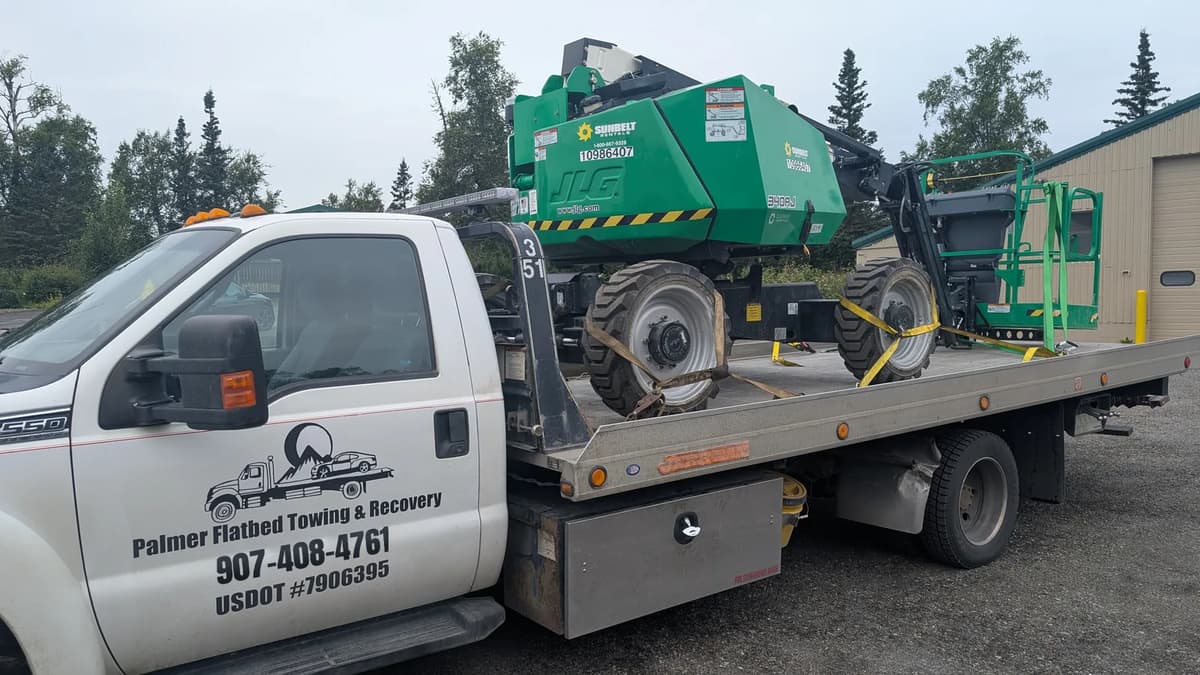
Illustrative heavy-load photo. Containers and equipment both need weight and access reviewed before dispatch.
Connex containers are popular across the Mat-Su for storage, workshops, and job sites. They are tough and weather resistant, but a steel box does not flex or forgive much when you move it. A little planning decides whether delivery is routine or impossible.
We handle 20-foot Connex moves when access, weight, and the load on the deck all check out. Every job gets reviewed before approval, and this checklist covers what we will ask about.
Start with the container itself
Confirm the container's actual length, width, and height. Standard and high-cube containers differ in height, and that difference matters under wires and branches. Look for a data plate with its tare weight, which is the empty weight, and include that in your request.
Empty containers are much easier to move. Anything stored inside adds weight and can shift, changing how the load sits on the deck. If it cannot be fully emptied, tell us what is inside and how much it weighs. Check the floor, corners, and bottom rails for rust, because weak points can fail during a lift or pull.
Access checklist
- Minimum road and driveway width, including at gates and culverts.
- Lowest overhead clearance: wires, branches, carports, and signs.
- The tightest turn, and whether a long truck can make it.
- Steep grades or side slopes on the way in or at the placement site.
- Firmness of the ground along the whole route, not just at the site.
- A clear area at the end of the route for the deck to tilt and for the truck to pull out.
Picking and preparing the spot
Containers need a level, well-drained base. Sinking corners can make the doors hard to open, and sitting water speeds up rust. Gravel pads or blocks at the corners are common choices. Prepare the base before delivery, and make sure it is at the height you want before the container arrives.
Think about how you will use the doors. Allow enough room in front for them to swing fully, and for you to get things in and out. Set it down where snow can be cleared and meltwater will drain away. Look up as well, because a container dropped under power lines limits how it can be moved later.
How it gets on and off
Tell us the loading method at each end. A forklift, crane, or large loader changes the plan compared with a winch pull. Winching a container on and sliding it off takes room and a surface that can take the abrasion, and asphalt or a finished pad may be marked. Ask yourself what the container will slide across when it comes off the deck, and let us know.
Our rough limits are about 20 feet long and 10 feet wide, subject to approval. Pricing for containers and sheds is separate from light-duty towing, and includes a set amount of loading time, with extra time billed in increments. The pricing page has current rates by zone.
Sending a request we can review
Include the address or pin for both ends, the container's size and tare weight, photos of the route and the placement site, and your timing. We approve or decline after reviewing the details, and inaccessible or off-road delivery sites may be declined. Asking early gives you time to fix any problems, such as trimming a branch or adding gravel, before delivery day.
Before the truck arrives
Mark the corners of the final spot with stakes, move vehicles out of the approach, and unlock any gates. Have someone on site who knows the property and can make decisions. Keep children, pets, and bystanders well clear while the container is moving.
Related information
- Container and shed delivery
- Container and shed estimates
- Preparing a site for shed delivery
- Construction Material Towing
- Wasilla towing
- Palmer towing
- Photos: Sheds and chicken coops