
Highway calls are easier to plan when the driver shares a precise location and vehicle condition.
A breakdown on the Glenn Highway can leave a driver far from a street address, exposed to fast traffic, wind, and rapidly changing weather. The first job is to reduce immediate danger. Towing details come after people and traffic are protected.
Use the sequence below whether the vehicle stops near Palmer, Sutton, Glacier View, Eureka, or farther east. Conditions vary by mile, so a pin and travel direction are more useful than a town name alone.
Protect people before the vehicle
If the vehicle still moves and a safe shoulder or turnout is close, get as far from the travel lane as conditions allow. Turn on the hazard lights. If the vehicle blocks traffic, anyone is hurt, fuel is leaking, or the scene presents an immediate danger, call 911 before arranging a tow.
Stay inside with the seat belt fastened when leaving the vehicle would put you closer to traffic. Move to a protected location only when you can reach it without crossing active lanes or standing where another vehicle may slide. Follow law-enforcement or responder directions when they are present.
Describe the location so a truck can find you
Share a GPS pin, highway name, direction of travel, and the nearest mile marker, intersection, bridge, turnout, or recognizable landmark. Say whether the vehicle is fully on pavement, partly in a lane, on a narrow shoulder, below the road, or behind a guardrail.
Cell coverage can be uneven. Send the location and core facts in one text while service is available: vehicle year and model, what failed, whether it rolls and steers, visible damage, keys, passenger count, and intended destination. Add clear photos of the vehicle and the space around it when it is safe to take them.
Know when recovery comes before towing
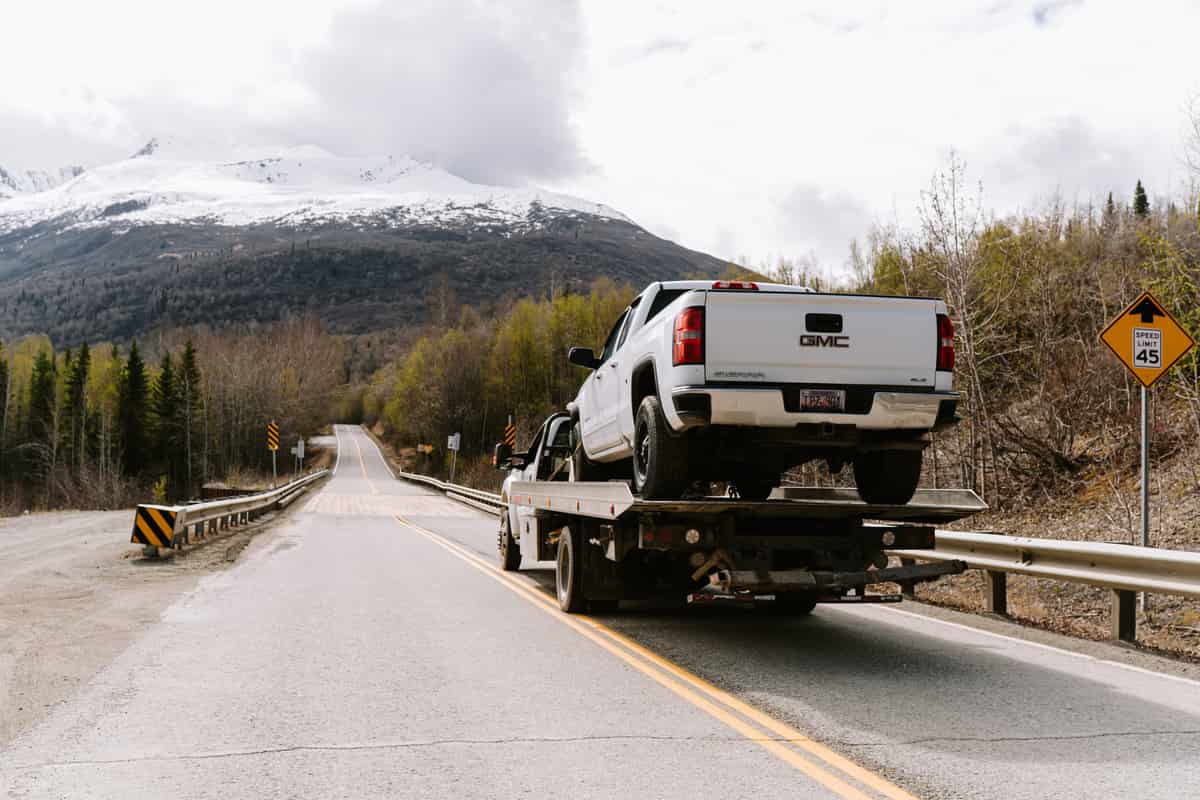
A vehicle resting on firm shoulder with usable wheels may be a straightforward flatbed load. A snowbank, soft ditch, locked wheel, collapsed suspension, or poor truck position can require recovery work before transport begins. Those details change equipment placement, time, and the estimate.
Do not keep spinning the tires to force a stuck vehicle back onto the road. Digging deeper can put the underbody on packed snow and make the pull more difficult. Leave the vehicle in a stable position and describe what is around it.
Prepare for a winter wait
Keep insulated layers, gloves, boots, a blanket, reflective markers, a flashlight, water, shelf-stable food, required medication, and a charged power bank in the vehicle. A compact shovel and ice scraper are useful even when self-recovery is not safe.
If the engine runs and you use it for heat, make sure drifting snow does not block the exhaust outlet. Conserve phone power after sending the location. Keep the keys available and remove only the valuables or supplies you need; loading instructions can wait until the operator reaches the scene.